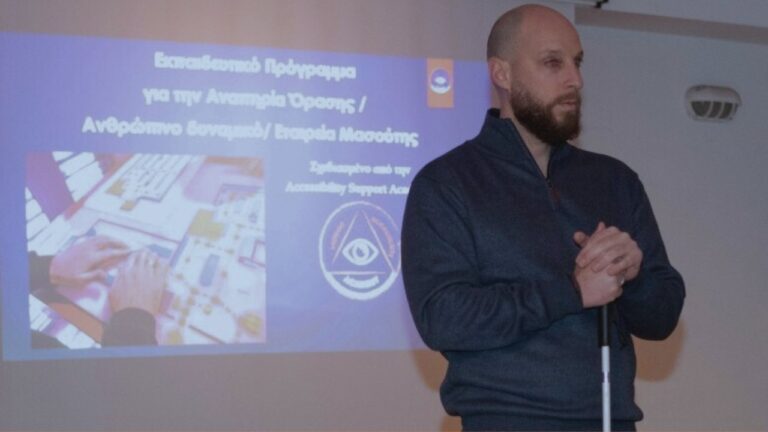
Despite technological progress and ongoing efforts to improve accessibility, Greek society continues to lag behind in terms of inclusion and support for individuals with visual impairments. This article examines the challenges faced by people with visual impairments in Greece, focusing on accessibility in urban environments and buildings, as well as on social awareness and education. It also explores the management of daily life and emotional challenges, including anger, experienced by individuals with visual impairments.
Accessibility in Urban Environments and Buildings
Accessibility is a fundamental prerequisite for independent living and social participation for individuals with visual impairments. In Greece, however, the situation remains problematic. Sidewalks are often poorly maintained or obstructed by obstacles such as parked vehicles and construction materials, making mobility difficult for people with visual impairments. In addition, street signage and audio announcements on public transportation are frequently inadequate or entirely absent.Public and private buildings also present serious accessibility shortcomings. Despite legislation requiring the installation of elevators and other assistive facilities, the implementation of these measures remains insufficient. The lack of tactile signage and other assistive features within buildings constitutes a significant barrier, complicating mobility and limiting the ability of individuals with visual impairments to live independently.
Social Awareness and Education
One of the greatest obstacles faced by individuals with visual impairments in Greece is the lack of knowledge and understanding within society. Many people are unsure how to communicate with or appropriately support individuals with visual impairments, leading to misunderstandings, prejudice, and instances of social isolation. Public education and awareness are essential to changing this reality.
Awareness campaigns and educational programs can play a key role in sensitizing the public and promoting a society that respects and upholds the rights of individuals with visual impairments. It is important to recognize that disability is not an individual problem, but a societal one—arising from the failure to provide the appropriate conditions for the inclusion of all citizens.
Everyday Challenges and Anger Management for Individuals with Visual Impairments in Greece
People with visual impairments face numerous daily challenges that require patience, resilience, and resourcefulness to overcome. From navigating public spaces to interacting with public services and participating in social life, these challenges are many and often discouraging. Addressing them effectively requires an approach grounded in respect and self-esteem.
Support from family, friends, and specialized services can make a significant difference in this process. Another critical issue is the management of anger and frustration that may arise from ongoing daily difficulties. Anger is a natural response to injustice and adversity; however, learning to manage it constructively is vital for maintaining mental health and overall well-being.
Proposals for Improving the Quality of Life of Individuals with Visual Impairments in Greece
Improving the quality of life of individuals with visual impairments in Greece requires coordinated efforts from the state, local authorities, organizations, and society as a whole. Legislative measures must be implemented consistently and accompanied by regular inspections to ensure full accessibility across all public spaces and buildings.
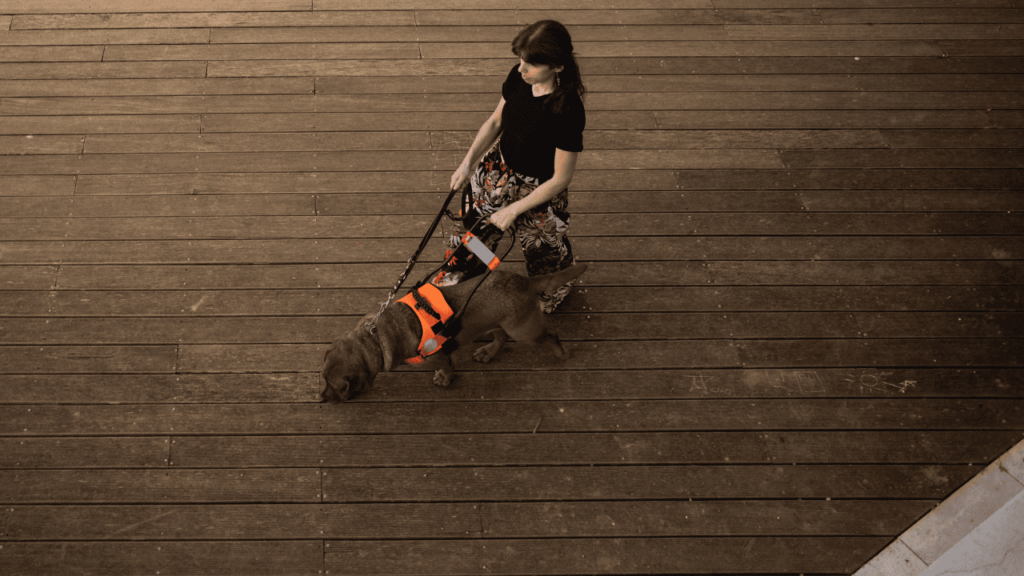
Technological innovations can play a decisive role in enhancing the everyday lives of people with visual impairments. Mobile applications that provide audio guidance, specially designed GPS systems, and other technological solutions can significantly strengthen independence and autonomy.
Public education efforts must continue and expand, with the aim of eliminating prejudice and promoting a culture of respect and inclusion. Schools and universities, in particular, can play an important role in educating younger generations about disability and accessibility.
Conclusion
Visual impairment is not a barrier to full participation in social and professional life. With appropriate infrastructure, technology, and education, we can create a society in which every individual—whether with or without a disability—can live safely, independently, and on equal terms. Managing everyday challenges and emotional responses such as anger is an integral part of this effort, while strengthening self-confidence and fostering a positive outlook are key to the well-being of individuals with visual impairments.